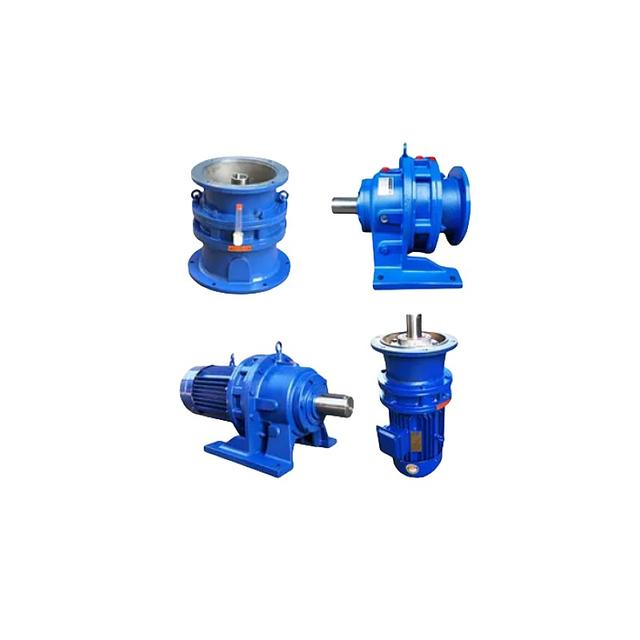
The cycloid reducer is a common industrial transmission device, which has some unique features and advantages during use.Among them, the output shaft diameter is one of the important differences between the cycloid reducer and other reducers.In this article, we will explore how the output shaft diameter of a cycloidal reducer differs from that of a conventional reducer.
First, we need to understand the working principle of the cycloid reducer.The reducer uses a pin wheel and a cycloid wheel for transmission, and the transmission effect is achieved by cooperating between the rolling of the pin wheel and the sliding of the cycloidal wheel.Compared with traditional reducers, cycloidal pinwheel reducers have higher transmission efficiency and lower noise.This is due to the unique structure and design of the cycloid reducer.
In the cycloid reducer, the output shaft diameter is a very important parameter.It determines the load-bearing capacity and stability of the reducer.The output shaft diameter of a cycloid reducer is usually smaller than that of a conventional reducer.This is because the cycloid reducer uses multiple teeth on the cycloid to share the torque, thereby reducing the stress on each tooth.Therefore, on the premise of ensuring the transmission effect and reliability, the cycloid reducer can achieve a lighter structural design by reducing the diameter of the output shaft.
In addition, the output shaft diameter of the cycloid reducer is also affected by other factors.For example, the reduction ratio and workload will place requirements on the output shaft diameter.Higher reduction ratios and greater workloads usually mean a larger diameter output shaft is required to ensure transmission effectiveness and stability.A lower reduction ratio and smaller workload can appropriately reduce the output shaft diameter to achieve a lighter design.
To sum up, the output shaft diameter of the cycloidal pinwheel reducer is somewhat different from that of the traditional reducer.Cycloidal reducers typically feature smaller diameter output shafts to achieve a lighter weight design.However, the specific output shaft diameter is also affected by factors such as reduction ratio and workload.