Currently, the mainstream reducers used in the printing and dyeing industry are mainly divided into two categories: worm gear reducers and helical gear reducers. Many factories do not know how to distinguish the adaptation, and blind purchasing leads to poor equipment adaptability, high energy consumption, and many failures. A detailed comparison of the advantages, disadvantages, and adaptation scenarios of the two reducers will help printing and dyeing companies accurately match equipment without wasting money.
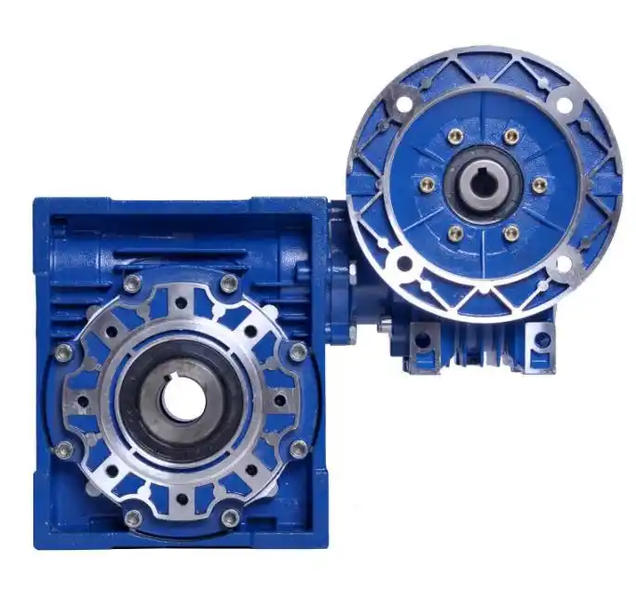
1. First, let’s talk about the worm gear reducer, the representative model NMRV series, which is a commonly used model for small and medium-sized printing and dyeing machines. The core advantages are small size, flexible installation method, extremely low noise, built-in self-locking function, high safety, and outstanding cost performance. The screen frame lifting, small slurry stirring, and rewinding and unwinding auxiliary mechanisms of the printing and dyeing machine have a small installation space, so they are very suitable for using worm gear reducers. At the same time, it runs smoothly without producing violent vibrations, and can effectively prevent thin fabrics from stretching and deforming.
However, it also has obvious shortcomings. The transmission efficiency is relatively low. It wears out quickly during long-term overload operation. It is not suitable for large-scale high-speed printing and dyeing production lines and heavy-duty styling equipment. It is only suitable for small and medium-power, intermittent or stable continuous working conditions.
2. Looking again, helical gear reducers, with R series and KF series as the core, are the main models of large-scale printing and dyeing production lines. The advantages are very prominent: transmission efficiency is as high as 94%-98%, lower energy consumption, strong power output, multi-stage transmission design can achieve large reduction ratio, full low-speed and high-torque performance, and is perfectly suitable for heavy-load working conditions such as the main drive of printing and dyeing machines, large cloth guide rollers, and high-speed dyeing machines. At the same time, the gears have high precision, are wear-resistant and durable, and the accuracy decays slowly in long-term operation, which can meet the process requirements of high-precision printing and uniform dyeing.
The disadvantages are that the body is relatively larger, the purchase cost is slightly higher, the installation space requirements are higher, and the adaptability of small and simple printing and dyeing equipment is poor.
3. Final Selection summary: For small printing machines, auxiliary transmission, and working conditions with limited space, choose worm gear reducers, which are cost-effective and quiet in operation; for large dyeing machines, setting machines, high-speed continuous production lines, and high-precision printing and dyeing processes, give priority to helical gear reducers, which are stable, durable, energy-saving, and have a lower failure rate.