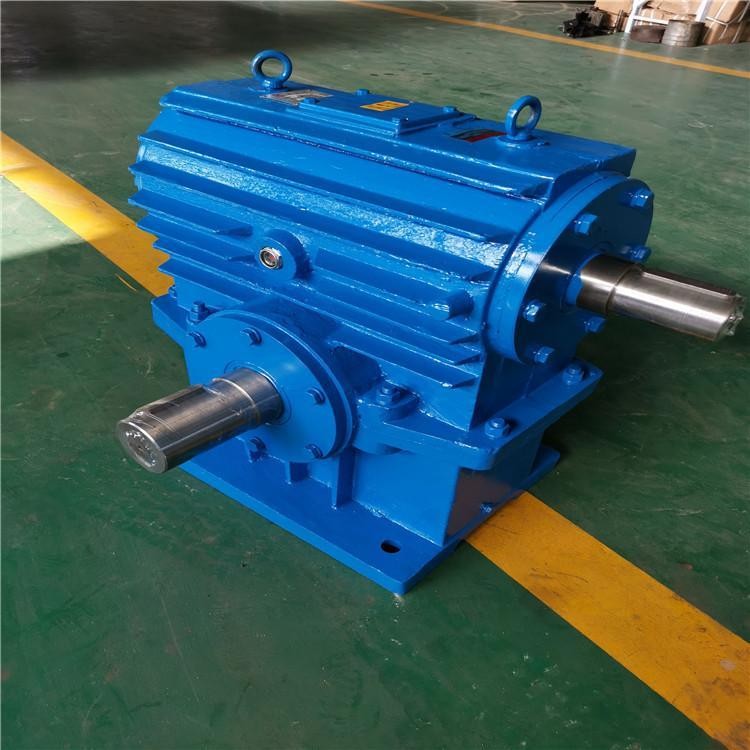
Worm gear reducer is a kind of transmission machinery with compact structure, large transmission ratio and self-locking function under certain conditions.It is one of the most commonly used reducers.
Transmission principle
A worm drive consists of a worm and a worm gear.Usually, the worm is the driving part.Worms and threads can be divided into right-handed worm drives and left-handed worm drives, which are called right-handed worms and left-handed worms, respectively.A worm with only one helix is called a single-head worm, that is, the worm rotates once and the turbine rotates one tooth.If there are two spirals on the worm, it is called a double-ended worm, that is, the worm rotates once and the worm gear rotates two teeth.
A worm drive is a transmission device that transmits motion and power between two shafts that are staggered in space.The angle between the two axes can be any value, generally 90°.Worm drives are used to transmit motion and power between interleaved shafts.
Main material
Shell: (030-110) aluminum alloy integral casting
Worm: 20CrMnTi carburizing and quenching, tooth surface hardness HRC58-62, surface finish of some precision grinding parts can reach Ra0.4
Worm gear: high-quality tin bronze casting (long service life, low temperature rise)
Coating: After the aluminum alloy shell is formed, heat treatment and shot blasting are performed to remove surface burrs and casting fine burrs.Phosphating treatment is carried out before painting, and then plastic spraying is carried out.The product has stronger corrosion resistance
Features
(1) Large transmission ratio and compact structure.The number of worm heads is represented by Z1 (generally Z1=1~4), and the number of worm gear teeth is represented by Z2.It can be seen from the transmission ratio formula I=Z2/Z1 that when Z1=1, that is, when the worm is single-headed, the worm must rotate Z2 first, and the worm wheel rotates once, so a larger transmission ratio can be obtained.Generally, in the power transmission, the transmission ratio takes i=10-80; in the indexing mechanism, i can reach 1000.Such a large transmission, such as gear transmission, requires multi-stage transmission, so the worm transmission has the advantages of compact structure, small size and light weight.
(2) The transmission is smooth and noiseless.Since the worm gear teeth are continuous helical teeth, they are continuous when meshing with the worm gear teeth, and the worm gear teeth do not move in and out during the meshing process, so the work is stable, and the impact, vibration and noise are relatively small.
(3) Self-locking.When the helix angle of the worm is small, the worm can only drive the worm wheel, but the worm wheel cannot drive the worm to rotate.
(4) High heat generation will wear the tooth surface
installation conditions
Check the direction of rotation of the output shaft before installation
Please pay attention to protection when using in harsh environment
Lubricate surfaces to prevent rust or oxidation
The maximum load cannot be applied immediately at start-up, it must be increased gradually
Common Troubleshooting
1. The worm gear reducer is overheated
1. The reasons for the overheating of the reducer are:
A sort of.Reducer overload;
Insufficient or excessive lubricating oil of reducer;
2. How to deal with the overheating of the reducer
The staff can check the actual load of the reducer in detail and adjust it to the specified value, or replace the high-power reducer and use lubricating oil strictly according to the specified fuel consumption.
2. The abnormal noise of the worm gear reducer
1. The reasons for the abnormal operation of the reducer are:
A sort of.The bearing on the reducer is damaged due to the rotation and grinding noise of the reducer;
b. knocking and irregular meshing;
2. The processing method for the abnormal operation of the reducer is as follows:
Check the grease inside the reducer.If the user cannot solve it by himself, he can contact the user service agency to help solve the problem.