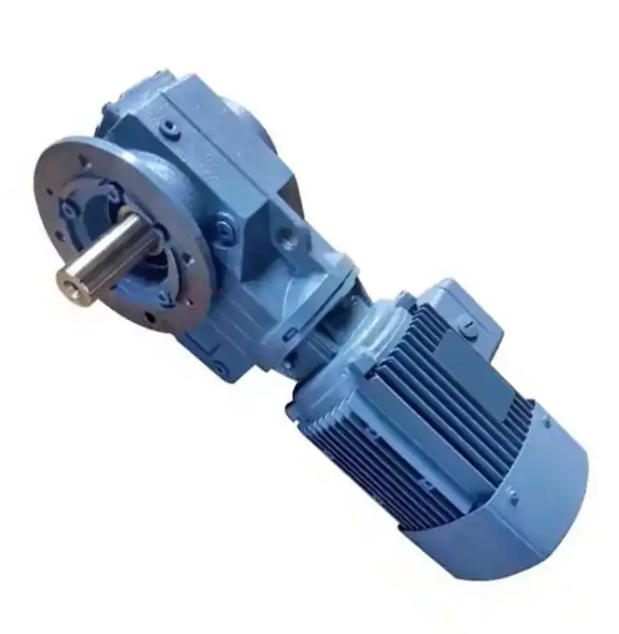
The splash lubrication system of this type of reducer, in addition to regular oil level and oil product inspections, must focus on monitoring three major parameters: temperature, vibration and oil quality, in order to capture early signals of lubrication failure in real time and prevent damage to gears and bearings. The following are specific monitoring parameters and implementation suggestions:
1. Temperature parameters: monitor 'key point temperature rise' and identify lubrication abnormalities
The splash lubrication effect directly affects the heat dissipation ability of bearings and gears. Abnormal temperature is often the first signal of insufficient lubrication or oil quality deterioration.
1. Bearing end temperature
The input/output shaft bearing is the most sensitive area for lubrication. It is recommended to install a contact thermal resistance (PT100) or infrared temperature measurement device.
Normal operation threshold: ≤70℃ (when the ambient temperature is ≤35℃); if the ambient temperature rises, the upper limit can be adjusted by 2℃ for every +5℃.
Early warning standard: temperature rise rate ≥10℃/h, or continuously higher than 80℃, indicating possible oil shortage, bearing wear or cage failure.
2. Oil chamber temperature
Oil temperature directly affects viscosity, and if it is too high, it will cause the oil film to rupture. It is recommended to set a temperature measurement point at the lowest point of the oil pool.
Normal range: ≤65℃, and the temperature difference with the environment is ≤30℃; when it exceeds 70℃, the viscosity drops by more than 30% and the lubrication performance is significantly deteriorated.
3. Shell temperature distribution
Determine the uniformity of heat dissipation through multi-point temperature measurement to avoid local overheating. Under normal circumstances, the temperature difference between the shell and the environment should be ≤25°C.
2. Vibration parameters: Capture 'precursors of mechanical deterioration' and analyze linkage lubrication status
Vibration changes can reflect the gear meshing quality and bearing status. Poor lubrication will accelerate wear and cause increased vibration.
1. Monitoring position : Install a three-axis acceleration sensor (range ±10g, frequency response 0–5000Hz) on the reducer housing near the gear meshing area. The sampling frequency is ≥1000Hz to capture high-frequency impact signals.
2. Judgment criteria:
Vibration speed effective value (RMS) ≤ 2.8 mm/s: good condition
2.8~7.1 mm/s: Pay attention to the status and need to strengthen monitoring.
7.1 mm/s: Abnormal status, it is recommended to stop the machine for inspection.
3. Special warning: If high-frequency impact vibration >100Hz occurs, it may be metal dry friction or micropitting caused by insufficient lubrication, which needs to be confirmed by oil quality analysis.
3. Oil quality parameters: Realize 'real-time early warning of deterioration' to avoid chain damage caused by contamination
The lubricating oil in the splash lubrication system is easily contaminated by the intrusion of dust and moisture. Especially in industrial site environments, it is necessary to break through the limitations of traditional 'regular sampling'.
1. Changes in oil viscosity
It can be monitored through an online viscosity sensor. If the viscosity drops by more than 20%, it will indicate the risk of oxidation or dilution.
2. Pollutant detection
Focus on monitoring particulate matter (such as metal abrasive particles, dust) and moisture content. It is recommended to configure an oil particle counter or moisture sensor.
If a sudden increase in the concentration of iron-based particles is found, it may be an early sign of gear or bearing wear.
3. Chemical state of oil
The degree of oxidation can be judged by the change in acid number (TAN). If the acid number rises rapidly, it indicates accelerated oil aging and the oil needs to be changed in advance.