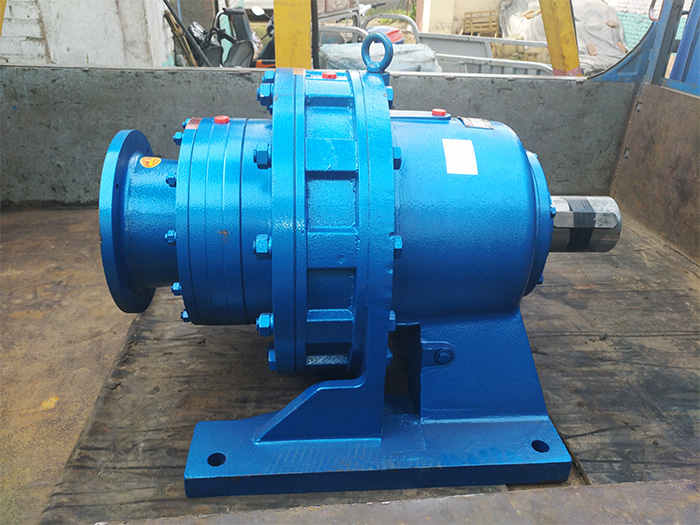
Generally, the blank material for making the gear of the reducer needs to be forged to eliminate the carbide segregation in the steel, which is conducive to obtaining qualified metallographic structure and performance, and ensuring the strength and impact toughness required for the gear of the reducer to work under complex loads. The process is: cutting blanking - forging - normalizing or quenching and tempering - car outer circle and hole drawing - stress relief annealing - finishing (drawing, inserting, milling, planing, etc.) - carburizing, low temperature nitrocarburizing.
The preparatory heat treatment of the reducer gear refers to the most commonly used heat treatment for the formed tooth blank, that is, annealing or normalizing treatment and quenching and tempering treatment.Normalizing or annealing is generally arranged after casting or forging, that is, before rough machining. Tendency to warp and crack.The normalizing temperature is 900~970℃, and the hardness is 156-269HBW.The purpose of quenching and tempering treatment is also to refine the grain and uniform structure.Due to the tempered sorbite structure, the toughness of the tooth blank is higher, and this process is generally arranged after rough machining (such as low carbon steel).In addition, stress relief treatment is carried out on some gears of the reducer, which can stabilize the structure and reduce deformation.
For carburized gears, the usual heat treatment process is: cleaning the surface of the part - furnace - carburizing, quenching - intermediate inspection - cleaning - tempering - calibration spline hole.
Usually, the gear of the quenched and tempered reducer is characterized by large size and weight, easy design, processing and heat treatment, easy running-in during the working process, and requires high tooth root strength and strong impact resistance. Therefore, heavy gears with less strict requirements In transmission, this type of gear has a relatively large proportion.Common quenched and tempered gear materials and heat treatment processes are as follows:
1. Pre-heat treatment: After thermal deformation of the billet of the quenched and tempered reducer gear, pre-heat treatment is required to reduce hardness, improve machinability, and coarse grains and banded structures caused by improper forging and rolling to eliminate thermal processing The structural defects and grain refinement caused by the time, so as to prepare for the final heat treatment of the gear of the reducer.
The usual preparatory heat treatment includes normalizing or annealing. For carbon steel and low alloy steel, normalizing or annealing is used; for alloy steel or steel with high hardenability, normalizing + high temperature tempering or normalizing is used. + High temperature annealing.
2. Final heat treatment-quenching and tempering treatment: In order to obtain the required structure and performance, it is necessary to quench and temper the gear of the quenched and tempered reducer to obtain a sorbite structure with good comprehensive mechanical properties.After the gear is heated, the hardenability, deformation and cracking tendency of the steel should be considered, and the best quenching cooling medium should be selected under the premise of ensuring hardening, effectively controlling deformation and avoiding cracking.
The second type of temper brittleness of steel needs to be considered during high temperature tempering. For carbon steel without such brittleness, high cooling is used, while for alloy steel gears, rapid cooling in water or oil is required after tempering.
3. Precautions for gear heat treatment of reducer
3.1 Normalizing the gear of the reducer is a necessary and critical process. Reducing the hardness of the gear blank after thermal processing, improving the structure, and eliminating defects will lay a good foundation for subsequent machining and quenching and tempering.
3.2 The basic requirements for quenching and tempering of reducer gears are that the metallographic structure, hardness and deformation meet the requirements. Therefore, when preparing the heat treatment process, a series of process parameters should be determined according to the performance of the selected heat treatment equipment, heating temperature, cooling medium, and cooling method. Validate to find out the best process parameters.
3.3 The pre-cooling quenching method or dual-medium quenching method is an important measure to reduce the thermal stress in the quenching process, which can effectively reduce deformation and cracking; in addition, the sub-temperature quenching method is a method to obtain better strength and toughness of gears, and has also been obtained Wider range of applications.
What kind of oil is added to the tricycle gearbox, technical parameters of zly180 reducer, elastic support of gearbox, Dezhou reducer factory, lightnin reducer
What lubricating oil is good for the gearbox, r∨ reducer, Taian Taishan Fushen gearbox, Hangzhou 300 gearbox manual, the difference between jzq reducer and zq reducer