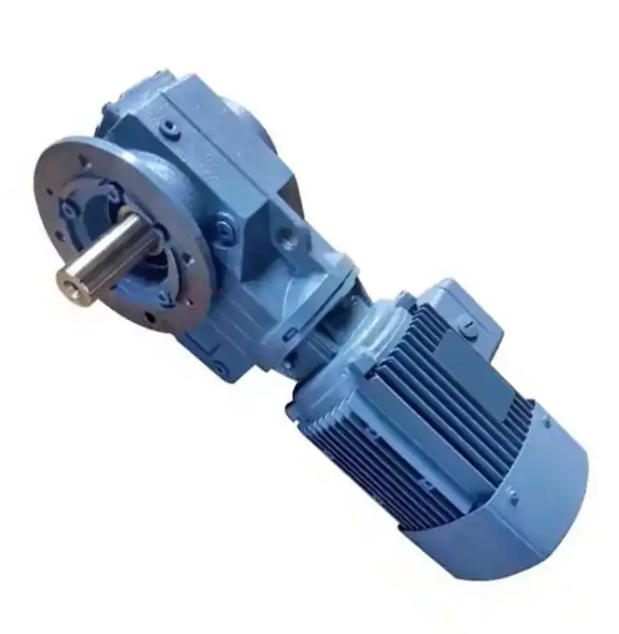
The R97-5.5-53.47 hard-tooth surface reducer is a helical gear transmission. The core assembly accuracy directly determines the smoothness, noise, life and load-bearing capacity of the transmission. It requires precise control from four aspects: part preprocessing, core component assembly, gap control, and detection and calibration.
1. First of all, parts pretreatment and cleaning are the basis for accuracy. Before assembly, all parts such as the box, gear shaft, bearings, and end covers must be thoroughly cleaned to remove burrs, iron filings, oil stains, and anti-rust coatings, especially key mating surfaces such as the box joint surface, bearing holes, gear tooth surfaces, and journals. Residue impurities are strictly prohibited. Re-inspect the flatness, coaxiality and hole position accuracy of the box. The coaxiality error of the bearing hole of the box must be controlled within 0.015mm, and the flatness of the joint surface is ≤0.03mm/m. Deformation that exceeds the tolerance needs to be ground and repaired. Gears need to be tested for tooth direction, tooth profile accuracy and end face runout. Hardened gears need to ensure an accuracy of level 6 or above. Shaft parts must be tested for circular runout and journal size tolerance. Unqualified parts are strictly prohibited from assembly. At the same time, the bearings need to match the clearance according to the model, and C3/C4 clearance bearings should be selected according to the working conditions in advance to avoid abnormal clearance after assembly.
2. Secondly, the assembly of core transmission components strictly controls coaxiality and verticality. The gear shaft assembly adopts the order of "installing the high-speed shaft first, then the intermediate shaft, and finally the low-speed shaft". Special tooling is used for positioning to ensure that the parallelism of the center lines of each axis is ≤0.02mm/100mm, and the center distance deviation is controlled within ±0.03mm. The bearings are installed using hot mounting (heating temperature is 80-120°C, over-temperature damage to the bearing is strictly prohibited) or cold mounting. It is prohibited to knock the inner ring/outer ring of the bearing to ensure that the interference fit between the bearing, journal and box hole is in place and there is no unbalanced load; the bearing end face must fit closely with the shaft shoulder and hole shoulder, with a gap of ≤0.02mm. When assembling the gear, use a dial indicator to detect gear end face runout (≤0.03mm) and radial runout to ensure uniform tooth surface meshing contact spots. The contact area accounts for more than 70% of the tooth width and more than 60% of the tooth height to avoid unbalanced meshing.
3. Furthermore, the meshing clearance and axial movement are precisely controlled. The backlash of the hard tooth surface gear must be matched according to the transmission ratio. The backlash of the R97 reducer is controlled at 0.08-0.15mm (module 8). This is achieved by adjusting the thickness of the bearing end cover gasket and the size of the shaft sleeve. Use a feeler gauge or dial indicator to detect the backlash. If the backlash is too large, it will be prone to impact, and if it is too small, it will be prone to heat and jamming. In terms of axial movement, the movement of the high-speed shaft is ≤0.05mm, and that of the low-speed shaft is ≤0.1mm. The locking nut, stop ring, and adjusting gasket are used to position the gear to prevent axial displacement during operation from causing eccentric wear of the tooth surface. When the boxes are combined, sealant should be evenly applied on the joint surface, and the bolts should be tightened diagonally, step by step, and torque specified (M10 bolt torque 45-50N·m) to avoid axis deviation caused by box deformation.
4. Finally, post-assembly inspection and running-in calibration. After the assembly is completed, manually turn the machine to check the operating flexibility, and there is no jamming or abnormal noise; use a dial indicator to detect the radial runout of the output shaft ≤ 0.05mm and the axial movement ≤ 0.1mm. Run-in without load for 2-4 hours, gradually load to the rated load, monitor the box temperature (≤80°C), vibration value (≤4.5mm/s), and noise (≤80dB). After running-in, replace the lubricating oil and remove internal wear debris. If the accuracy is not up to standard, disassemble and recheck the bearing clearance, gear meshing, and box coaxiality, and make targeted adjustments and repairs.
Through full-process precision control, the assembly accuracy of the R97 reducer can be improved to the design requirements, effectively reducing failures and extending service life.