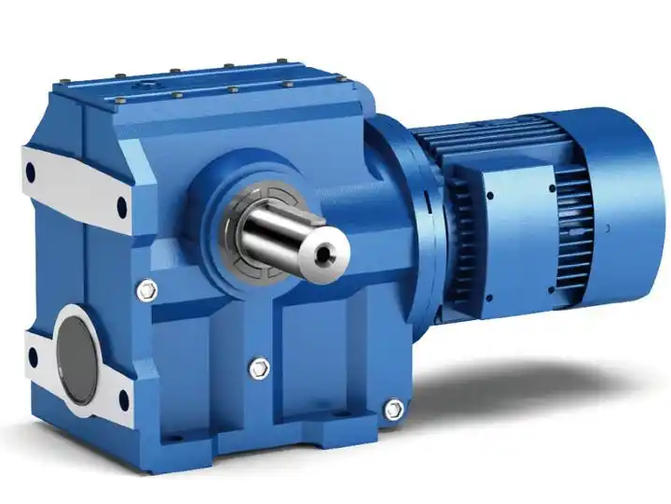
1. S series: the "self-locking king" that meets basic working conditions
The core technical feature of the S series reducer (helical worm reducer) is its self-locking function.
Technical features: It combines a helical gear and a worm gear structure, which can achieve reverse self-locking under low speed and high torque conditions, acting as a "safety lock". However, the worm drive has sliding friction, resulting in relatively low transmission efficiency (about 70%-85%), and attention must be paid to heat dissipation during long-term operation.
Industry mapping: In early equipment or specific links in the textile industry, the S series was mainly used in scenarios with high safety requirements and the need to prevent reversal, such as hoists, gate controls, etc. It solves the basic transmission and braking problems, but it is difficult to meet the pursuit of high speed, low energy consumption and precise control of modern spinning machines.
2. F series: "Compact engine" that drives efficiency upgrades
As the textile industry"s requirements for production capacity and yarn quality increase, the advantages of F series reducers (parallel-axis helical gear reducers) begin to highlight.
Technical features: The F series adopts a multi-stage parallel axis helical gear layout, with compact structure, smooth transmission and low noise. Its transmission efficiency is as high as 94%-96%, which is far better than the S series. In addition, it can achieve a large speed ratio in a small volume and has high load-bearing capacity and overload capacity.
Industry mapping: The high efficiency and stability of the F series perfectly meet the upgrade needs of modern spinning machines (such as two-for-one twisting machines and spinning machines). For example, in the servo transformation of Saurer"s two-for-one twisting machine, the new transmission system greatly increased the upper limit of the winding speed, made the twist control more precise, and the operation was smoother and less noisy. In the upgrading of the spinning machine, the application of fully variable frequency motors and intelligent speed regulation technology has increased the output of each shift by 50%, while reducing water and electricity energy consumption and yarn defect rates. The F series reducer is one of the core power sources of these efficient and precise transmission systems.
3. The history of industry efficiency upgrades behind technological iterations
From the S series to the F series, and now even used in conjunction with servo motors and precision planetary reducers (with the characteristics of high precision, high transmission efficiency, stable output, etc.), this technological evolution path clearly outlines the three major upgrade directions of the textile industry:
From "usable" to "highly efficient and energy-saving": the improvement in transmission efficiency directly translates into a reduction in energy costs. In the context of energy costs accounting for an important part of textile mill expenses, high-energy-efficiency reducers such as F series have become the key to reducing costs and increasing efficiency for enterprises.
From "extensive" to "precision and intelligent manufacturing": Modern textiles have extremely high requirements for yarn consistency and evenness. F series and more precise reducers provide smooth and precise power output, which is the basis for achieving stepless adjustment, reducing yarn defects and increasing the added value of products.