WeiGao Transmission
Email: sales@wgt.net.cn
Language
通栏图2
tonglantu.jpg
Home / News

News Center

  • The difference between high and low speed cutting machine reducers Selection! Stop mixing things up

    2026-07-06

    The working conditions of high-speed and low-speed cutting machines vary greatly. If reducers are used interchangeably, it will easily lead to reduced equipment accuracy, shortened service life, and even shaft damage. There are significant differences in core parameters, type selection and transmission structure between the reducers of high-speed and low-speed cutting machines: 1. High-speed cutting machine reducer Selection Features High-speed cutting machine pursues high beat, high acceleration and ultimate dynamic response. The requirements for the reducer focus on 'light, fast and accurate': 1. Extremely high accuracy and backlash requirements: Under high-speed operation, the return gap (backlash) of the reducer must be extremely small, usually ≤1 arc minute or even lower. Excessive backlash will cause drift, saw cuts or wavy patterns during high-speed positioning. 2. High rigidity and impact resistance: When frequently starting, stopping and reversing at high accelerations such as 3.0G, the reducer must have extremely strong rigidity. For example, a micro cycloidal reducer with an R-angle tooth arc design is more impact-resistant than a harmonic reducer and will not operate at a specific speed. Read More
  • 5 major signs of aging and failure of cutting machine reducer!

    2026-07-06

    Cutting machine reducers usually send out clear 'early warning signals' before aging and failure. Timely identification of the following 5 major signs and early replacement or repair can effectively avoid greater economic losses caused by complete damage to the equipment: 1. Frequent abnormal noise. A normal reducer operates smoothly. If abnormal noise occurs, it is usually a sign of damage to internal parts. For example, persistent 'rustling' or grinding sounds may mean tooth surface wear or insufficient lubrication; periodic 'clicking' or banging sounds are highly suggestive of broken gear teeth, chipping, or bearing damage. 2. Abnormal temperature surge The reducer will generate heat during operation, but if the shell temperature rises significantly or even becomes hot to the touch, it is a serious abnormality. This is usually caused by insufficient/deteriorated lubricant, overloaded operation, cooling system failure, or excessive frictional heat generation due to increased internal wear. 3. Significantly aggravated vibration Abnormal vibration is an important sign of internal imbalance or component damage. When the gear is severely worn and the teeth are broken Read More
  • Comprehensive explanation of the main structural components of gear reducers and their functions

    2026-07-03

    Gear reducer is the core device of industrial and mechanical transmission systems. It is commonly used between the prime mover and the working machine. It plays the role of matching the speed and transmitting torque between the prime mover and the working machine or the actuator. A complete gear reducer is composed of multiple highly integrated components with clear functions, relying on these components to jointly achieve the core functions of reducing speed, increasing torque, matching inertia and transmitting power. So, what are the main structural components of the gear reducer? What roles do these components play? 01 Gear As the name suggests, the gear is the most important part of the gear reducer, responsible for transmitting torque and speed. The design, material and processing accuracy of the gear directly determine the efficiency, noise, load-bearing capacity and life of the reducer. In the gear reducer, the teeth are in line contact with each other, and are severely worn during movement and need to withstand large impacts. Therefore, the gear needs to have a large surface hardness and a certain degree of toughness in the core. Generally, gears are Read More
  • Complete guide to planetary reducer: from principle to Selection, fault maintenance explained in one go

    2026-07-03

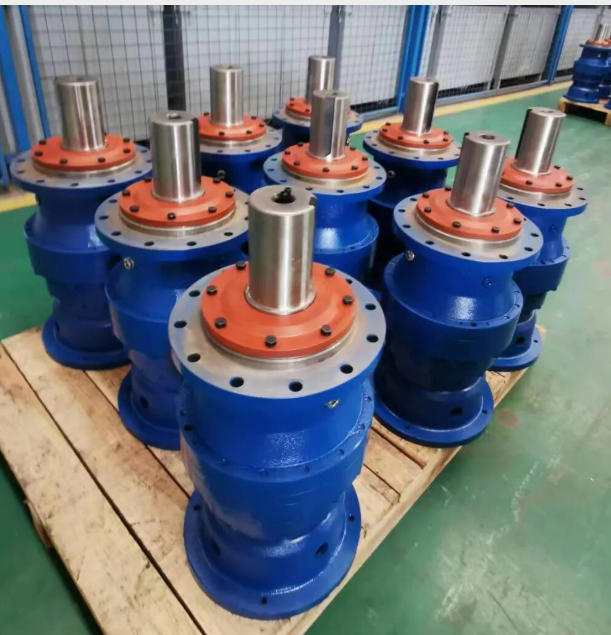
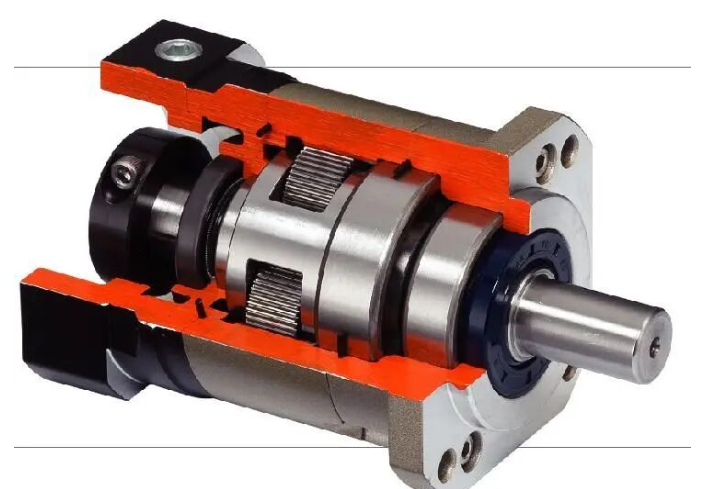
    The reason why the planetary reducer has become the core of high-precision transmission is due to its ingenious 'sun gear-planet gear-internal ring gear' structure. Many people think it is complicated, but in fact, it only takes 3 steps to understand: the power input motor drives the 'sun gear' in the center to rotate at high speed, just like the central star of the solar system; planetary revolution + rotation, 3-4 planetary wheels engage the sun gear and the fixed internal ring gear at the same time, 'rotating' around its own axis while 'revolving' around the sun gear; the revolution of the torque amplification output planetary wheel drives the planet carrier to rotate at low speed, ultimately achieving 'reducing speed and increasing torque'—— For example, when the transmission ratio is 100, the motor speed of 1500r/min can be reduced to 15r/min, and the torque can be amplified synchronously by nearly 100 times (ignoring efficiency loss). Key formula: transmission ratio i = number of teeth of the internal ring gear ÷ number of teeth of the sun gear + 1, precision Read More
  • From S series to F series: The technological iteration of spinning machine reducers hides the history of efficiency upgrades in the textile industry

    2026-07-02

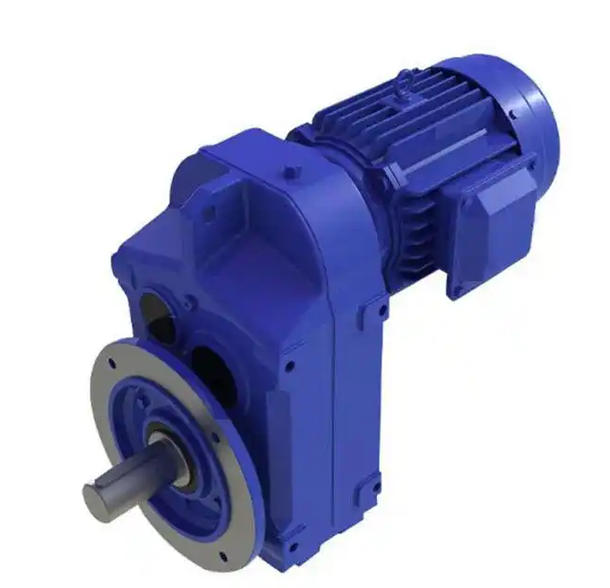
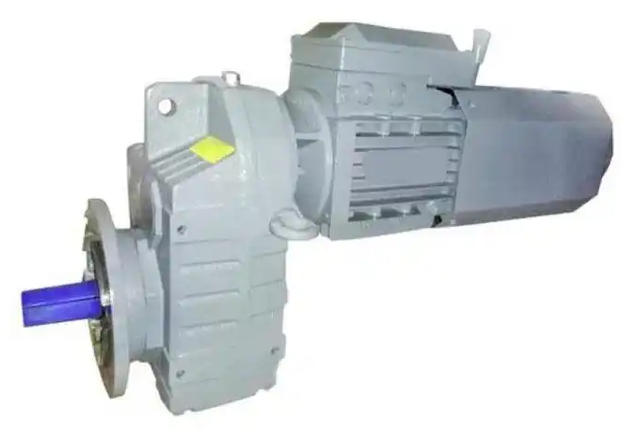
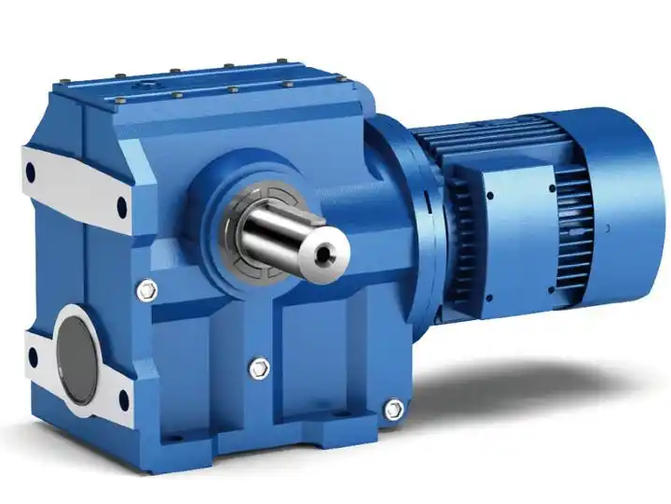
    1. S series: The core technical feature of the 'Self-locking King' S series reducer (helical gear worm reducer) that meets basic working conditions is its self-locking function. Technical features: It combines a helical gear and a worm gear structure, which can achieve reverse self-locking under low speed and high torque conditions, acting as a 'safety lock'. However, the worm drive has sliding friction, resulting in relatively low transmission efficiency (about 70%-85%), and attention must be paid to heat dissipation during long-term operation. Industry mapping: In early equipment or specific links in the textile industry, the S series was mainly used in scenarios with high safety requirements and the need to prevent reversal, such as hoists, gate controls, etc. It solves the basic transmission and braking problems, but it is difficult to meet the pursuit of high speed, low energy consumption and precise control of modern spinning machines. 2. F series: 'Compact engine' with upgraded driving efficiency. As the textile industry's requirements for production capacity and yarn quality increase, F series reducers (parallel-axis helical gear reduction Read More
  • 3 key details for installation and commissioning of spinning machine reducer

    2026-07-02

    1. Accurate alignment of the transmission axis. The alignment of the transmission center axis is crucial during installation, and its deviation must be strictly controlled within the compensation range of the coupling (it is recommended that the radial deviation be controlled within 0.05mm, and the angular deviation ≤0.02mm). If there is misalignment or the error exceeds the standard, the reducer bearing will bear unnecessary additional load, causing uneven force and local stress concentration. Practice shows that a misalignment of only 0.1mm may shorten bearing life by 60%. 2. Standardize installation and strictly prohibit violent knocking. When installing transmission parts (such as gears and sprockets) on the output shaft, it is strictly prohibited to use a hammer to knock directly. Violent knocking will cause raceway deformation, rolling element damage, and even damage to the internal parts of the reducer. The correct approach is to use the assembly clamp and the internal thread of the shaft end to press the transmission part smoothly through the bolt. In addition, the use of rigid fixed couplings should be avoided to avoid unnecessary external loads and premature bearing failure. Read More
  • Total 454 pages  Go to Page
  • Go

WeiGao Transmission

Weigao Gear Reducer is an alliance group company that integrates research and development, production, sales, and service

+86 400 801 9158

Email: sales@wgt.net.cn;wgt.net.cn@gmail.com
Tel:+86571 85023000

WEIGAO REDUCER

FEEDBACK